Invest for your future: The Crucial Benefits of Early and Consistent Investing

June 11, 2024

Balancing Cash Reserves and Investments: Why Strategic Investing Beats Hoarding Cash

We've been taught to save for a rainy day, which is wise to some extent. However, keeping all your money in cash over the medium to long term carries risks, too. In fact, doing nothing with your money is the biggest risk of all, as inflation will erode its value over time.


The amount of cash to hold as an emergency fund depends on individual circumstances. Generally, we recommend holding 3 to 12 months’ worth of living expenses. Any more can drag down your overall investment performance. For instance, a couple with two independent income sources, each capable of sustaining household expenses, plus having various protections like life and income insurance, might comfortably hold 3 months’ worth of expenses in cash. On the other hand, a single person with dependents, only one income, no protection plan, and no capacity for short-term lifestyle adjustments, might need 12 to 18 months’ worth of expenses.


Regardless of the risk profile you adopt, committing to regular investments will reap substantial future benefits, thanks to the power of compounding. People should treat regular investing for retirement like paying a mortgage. Under normal circumstances, missing a mortgage payment isn't an option, and the same mindset should apply to investments. It’s easy to reduce or pause monthly investments for temptations like holidays or new cars, simply because it is convenient to do so, but that isn’t an option with your lender, so why should it be a reason to stop investing for your future? 


Here’s an illustrative example: an individual invests £1,000.00 a month for 20 years. With a total investment of £241,000.00 (the monthly £1,000.00 remains fixed despite inflation reducing its real value over time), the final value of the investment, at assumed 3%, 5% & 8% returns are significantly higher than the original investment amount due to compounded growth. For example, an 8% return will produce a lump sum of £577,145.78, representing a growth of £366,145.78.
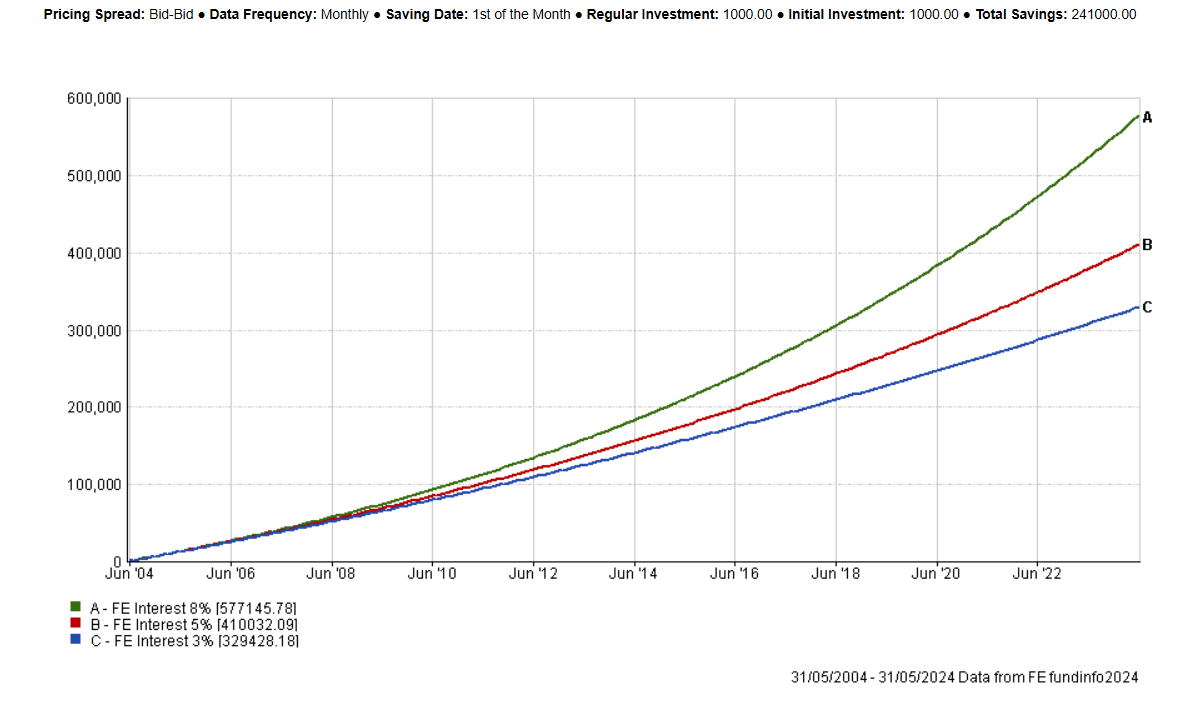

This chart demonstrates the power of building wealth steadily and deliberately. Although not everyone has a 20-year investment plan, we often encounter individuals who still set aside excessive amounts of cash for a rainy day. Statistically, the need for such large reserves is limited. It’s a difficult topic, but it’s crucial to address the pitfalls of holding too much cash vs. the benefits of investing wisely and making sure you stick to it.


Risk Warnings:


The information contained in this article is intended solely for information purposes only and does not constitute advice. The price of investments and the income derived from them can go down as well as up, and investors may not get back the amount they invested. Past performance is not necessarily a guide to future performance.

The Iron Wealth Blog
September 29, 2026
It’s Less About Numbers, More About Judgment
March 25, 2026
When Markets Don’t Feel Fair: How We Reduce the Risk of Being on the Wrong Side of the Trade
July 14, 2025
In the world of investing, there is always something trending and receives a lot of attention.
By Helen Yip • November 28, 2023
We are 5! This month we are celebrating Iron Wealth turning 5 years old. We are so ever thankful for everything we have achieved.
By Tony Yip • November 15, 2023
Is it worth switching your investment portfolio to cash? In this blog, we discuss why cash isn't all it's hyped up to be, even at 5%.
November 24, 2022
There is no better time to size your unsheltered portfolio correctly.
February 24, 2022
Fact: They are rare, inevitable and are a feature of the markets.
November 17, 2021
An Alternative Source of Income/Capital:  Equity Release & Retirement Mortgage
May 26, 2021
A common question that you may have heard or asked is “What is the income/yield?” But have you truly thought about the meaning of this question? Firstly, what do they mean by “yield”? Yield is what you get back from your investment, the interest or dividend you receive. Many people like the thought of a stable, sustainable income and therefore, they focus on obtaining a high income. This is especially true for those approaching and/or in retirement. After Years of earning a regular income through our wages, we are bias towards continuing this approach with our pensions and investments. This is another reason why most people would opt for an income stream in the form of a final salary pension over a lump sum. We saw an example of this when Camelot launched ‘set for life’ in 2019, where instead of winning the jackpot as a lump sum, the winner would receive £10,000 a month for life. A lump sum has its benefits too, it gives us flexibility, control, inflation proofing and the ability to manage counterparty risk (the probability of default). Of course, this all depends on individual circumstances and objectives. If you structure an investment portfolio for maximum income/yield only, or as your main objective, you distort the portfolio, leading to far higher risks and can potentially lead to higher taxation in the future.
October 23, 2020
As the impact of COVID continues to adversely affect business, it looks like further redundancies are inevitable. This may sound grim, but you can lessen the blow by getting financially prepared. For those who are still in employment and are facing potential redundancy, sometimes it helps to take a step back to see the bigger picture. Here are some questions that you can ask yourself? 1. Are you ready to take early retirement? 2. If not, how quickly can you get another job and at what pay? 3. How big is the carrot? 4. Do you want to retire now or do you want to tie this in with your partner? 5. Are you in good health? 6. What do you have planned for retirement? i.e. if it is travelling the world, then probably not the right time 7. What’s the job security like for your partner?
More Posts